
Cherokee County Court Records After Arrest
Cherokee County court records after a jail arrest begin after the jail booking side has created the intake record. The Cherokee County Jail may list a booking number, arresting agency, booking date, arrest charges, and bond. That jail profile is useful, but it is not the court docket. The court record is the district court case opened after a prosecutor files a complaint, information, or another charging document. Cherokee County is part of the Kansas 11th Judicial District, so district court records are searched through the Kansas court system and the local courthouse.
The local bridge between arrest records and court records is the Cherokee County Attorney's Office. Research identifies Kurt Benecke as County Attorney, with Assistant County Attorneys Addison Tucker and Ethan Manke. The office prosecutes criminal matters from sheriff investigations and city police departments across Cherokee County. That means a Baxter Springs, Columbus, Galena, sheriff, or state-agency arrest may first appear on the jail roster, then later appear as a court case after the County Attorney decides what formal charges to file.
For custody status, booking fields, and the current jail profile, use Cherokee County jail inmate records. For booking photos, use Cherokee County jail mugshots. For formal charges, hearing dates, warrants tied to a case, disposition, or expungement history, use the court record path instead.
Cherokee County CaseSearch Records
Kansas CaseSearch is the statewide public district court case-search system. Kansas court materials describe public lookup by case number and party name. For Cherokee County court records after arrest, start with the defendant's legal name as shown on the jail profile, then narrow to Cherokee County or the 11th Judicial District when the portal allows it. A recent booking may not have a filed case yet, so a blank search result does not prove that no charge will be filed.
The Kansas CaseSearch portal is shown in the screenshot used for public district court lookup.
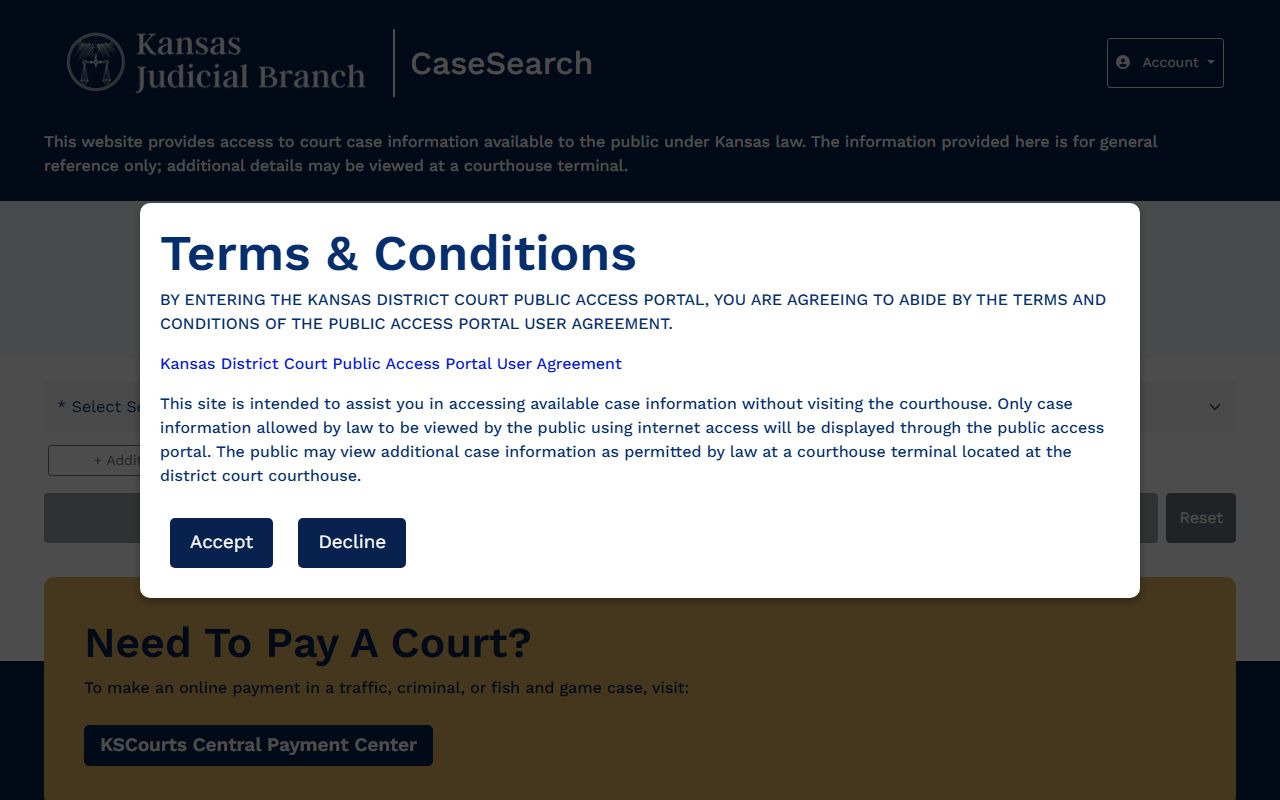
CaseSearch is the online starting point, while the Cherokee County Courthouse remains the fallback for written searches and public terminal access.
| Search Field | Type | Required | Use for Cherokee County |
|---|---|---|---|
| Case number | Text | Optional if using name | Best when jail staff, bond paperwork, a citation, or a court notice gives the exact case number. |
| Party name | Text | Optional if case number known | Use the defendant's legal name and try middle initials or spelling variants. |
| County or court | Filter | Usually optional | Choose Cherokee County or the 11th Judicial District when a narrowing option appears. |
| Case type | Filter | Optional | Criminal and traffic categories may help separate court records from civil cases. |
| CAPTCHA or robot check | Verification | Required when shown | Complete the portal's anti-data-mining check before viewing public case results. |
- Copy the name spelling, booking date, arresting agency, and listed charges from the jail profile.
- Search Kansas CaseSearch by party name, then narrow to Cherokee County if the result list is broad.
- Use a case number when jail staff, a bond company, or court paperwork has already supplied one.
- Compare filing date, defendant identity, charge text, and case status against the jail booking.
- Read the court charge list separately from the booking charge list because court records can change after filing.
Cherokee County Courthouse Fallback
The online court search is not the only access channel. The Kansas Judicial Branch district court records page says public court records are available at each courthouse and each court has a computer reserved for public searches. The Cherokee County Courthouse page states that all record search requests must be in writing, copies are 25 cents per page, the hourly search fee is $12, and the public access computer has cases beginning in 1990. That fallback matters when a new case has not indexed online, when the spelling is unclear, or when certified copies are needed.
The Cherokee County Courthouse court-record page lists the local copy fees and public computer details.
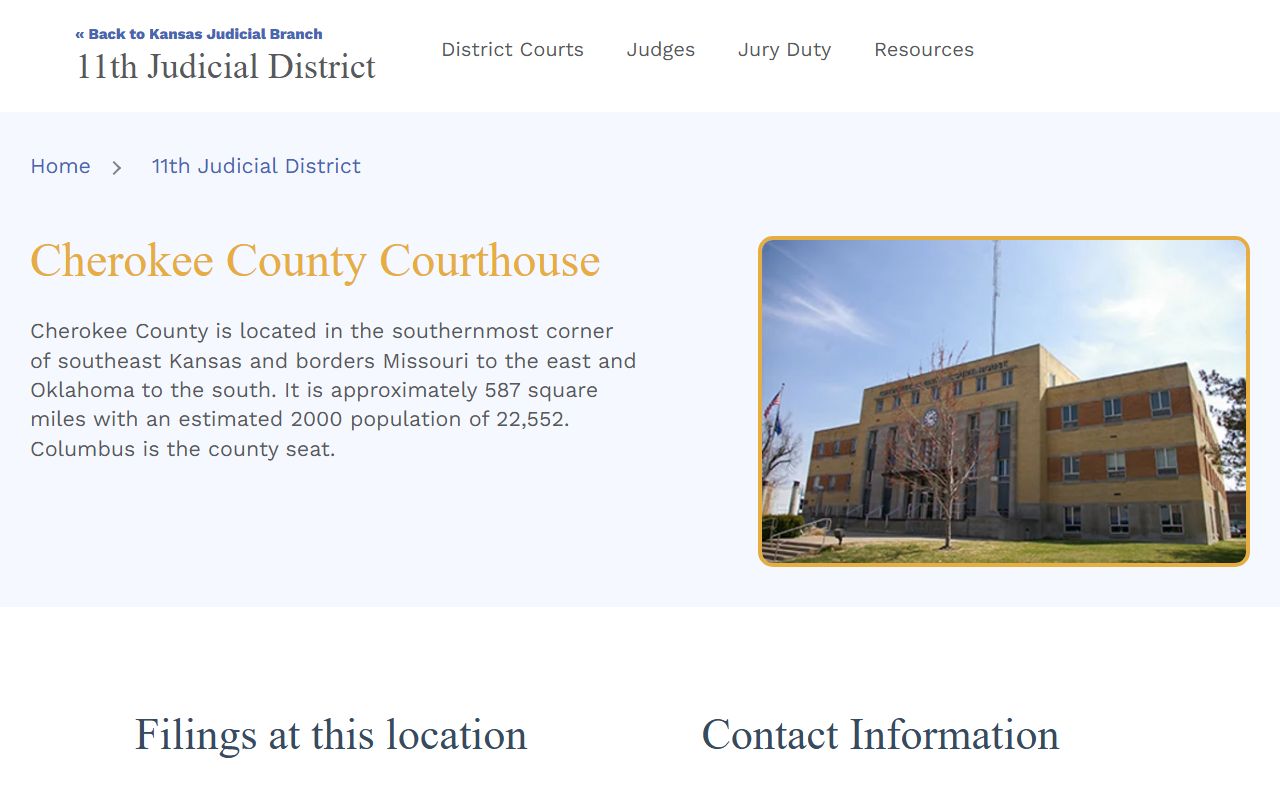
The courthouse route should be used for written searches, copies, certifications, and case files that require clerk review.
Cherokee County Attorney
110 W Maple St, Room 212
Columbus, KS 66725
620-304-3020 ext. 6
Prosecutor for criminal filings from Cherokee County law-enforcement investigations.
County Attorney contact is not a substitute for court-clerk copies. The prosecutor's office decides and pursues charges, while the district court clerk maintains public court records once the case exists.
Cherokee County Arrest Charging Documents
After a Cherokee County arrest, the jail may first list arrest charges supplied by the arresting agency. Formal court records start when the prosecutor files a charging document. Kansas criminal cases commonly use a complaint or an information, while an indictment is tied to grand jury action and is less common. The document matters because it sets out the formal allegation the court will track.
| Document | Who uses it | What it does | How to read it |
|---|---|---|---|
| Complaint | Prosecutor or officer-driven filing | Starts many criminal matters and states the alleged offense. | Compare the complaint to the jail charge, but expect wording to differ. |
| Information | Prosecutor | Sets formal charges, often in felony proceedings after prosecutor review. | Use it as the court charge record rather than the booking shorthand. |
| Indictment | Grand jury | Charges returned by a grand jury in cases where that process is used. | Treat it as a formal accusation, not a finding of guilt. |
A charging document can add a statute citation, amend the offense level, drop a jail-listed count, or file a different count based on the facts reviewed by the County Attorney. A pending case still remains an allegation until plea, trial, dismissal, diversion, or another final court action changes the status.
Cherokee County Charge Status
Charge status is the key reason to check court records after a jail arrest. The jail roster profile itself warns that charges and bail amounts may change after court appearances and may not be current. A court file can show whether the charge is pending, amended, dismissed, diverted, resolved by plea, or resolved at trial. Bond conditions and future hearing dates also move through the court record once a case is filed.
| Status | Plain meaning | Record caution |
|---|---|---|
| Pending | The case is open and the charge has not reached final disposition. | A pending charge is not a conviction. |
| Amended or reduced | The prosecutor or court changed the count or level from an earlier version. | Do not rely on the old jail charge once the court record changes. |
| Dismissed | The charge was ended without a conviction on that count. | Other counts or later filings may still exist. |
| Diversion | The case follows a court-approved agreement that may avoid conviction if completed. | Terms and visibility depend on the court file and Kansas law. |
| Convicted | The defendant was found guilty or entered a guilty or no-contest plea. | Use the final disposition, not the original booking charge. |
| Acquitted | The defendant was found not guilty at trial. | The arrest may still have a public record unless expunged or restricted. |
Bond Warrants and Court Records
Bond starts on the jail side but often changes in court. Cherokee County roster profiles can list a bond amount, yet the profile warning directs bond companies and people posting bail to call Detention Center staff at 620-429-3897 for the correct bail amount, charges, and case numbers. Cash bond, surety bond, personal recognizance, and no-bond holds each mean something different. A $0.00 listing can appear with probation violations, contract beds, or holds and should not be read as a release promise.
Warrants can also connect arrest records with court records. The sheriff's warrants page routes felony warrants to Most Wanted and gives 620-429-3992 for tips or information. Kansas CaseSearch may show bench-warrant history, failure-to-appear events, bond forfeitures, or next hearings when those events are public in a case. Municipal bench warrants may require checking the issuing city court if they do not appear on the sheriff's felony Most Wanted page.
- Detainer
- A request or hold from another agency that may block release even when local bond is resolved.
- Bench warrant
- A judge-issued warrant, often after failure to appear or violation of a court order.
- Personal recognizance
- Release based on a promise to appear and obey court conditions, often shortened to PR.
Note: Bond and warrant data should be checked with jail staff or the court before travel, payment, or surrender decisions.
Charges Convictions Sealed Expunged
Two comparisons help keep Cherokee County court records after arrest in context. A charge is an allegation, while a conviction is a final court outcome after plea or trial. A sealed or expunged record is about public access after a court order, not whether the arrest ever occurred. Kansas research points to K.S.A. 22-2410 for expungement of arrest records and K.S.A. 21-6614 for certain convictions, diversions, and related arrest records.
Charge vs. conviction: A charge is a formal accusation in the court case. A conviction follows a guilty plea, no-contest plea, or guilty finding. Booking charges and court charges can differ, so the final court disposition controls how the case ended.
Sealed vs. expunged: A sealed record is hidden from normal public access. An expunged Kansas arrest or conviction record is limited by court order under the eligible statute, but some justice agencies may still have lawful access.
Kansas Open Records Act access also has limits. The Cherokee County sheriff FAQ says public sheriff records usually include offense, arrest, and booking information, but exceptions can apply for open investigations, personnel records, sealed or expunged records, and juvenile records. Court records can have similar limits when a judge restricts access.
Cherokee County Record Limits
Public case lookup is not a full criminal-history report. The sheriff FAQ says the sheriff cannot run NCIC criminal-history background checks for private requesters and directs statewide background checks to the Kansas Bureau of Investigation. CaseSearch can help identify public district court cases, but it is not the same as a fingerprint-based background check, a consumer report, or a complete list of every law-enforcement contact.
KORA requests can fill some gaps for non-exempt sheriff, booking, offense, or arrest records. The county KORA form cites K.S.A. 45-215 et seq., includes requester and delivery fields, and requires K.S.A. 45-230 certification when name or address lists are requested. For court-file copies, the Kansas Judicial Branch also publishes a statewide court-record request page. Search fees, information fees, copy fees, and mailing charges may apply under the local form.
Important: Public court lookups are not FCRA consumer reports and should not be used for employment, housing, credit, or insurance screening.